 By Admin
 August 17, 2026
Manual lifting still shows up in more production lines than it should. Workers hauling sacks up a platform or feeding a hopper by hand because nobody's automated that one stretch of the process. It works, until it doesn't. Fatigue causes delays in the flow of work, accidents make employees unable to work, and the throughput is ultimately limited by the speed at which an individual can physically transport materials uphill.
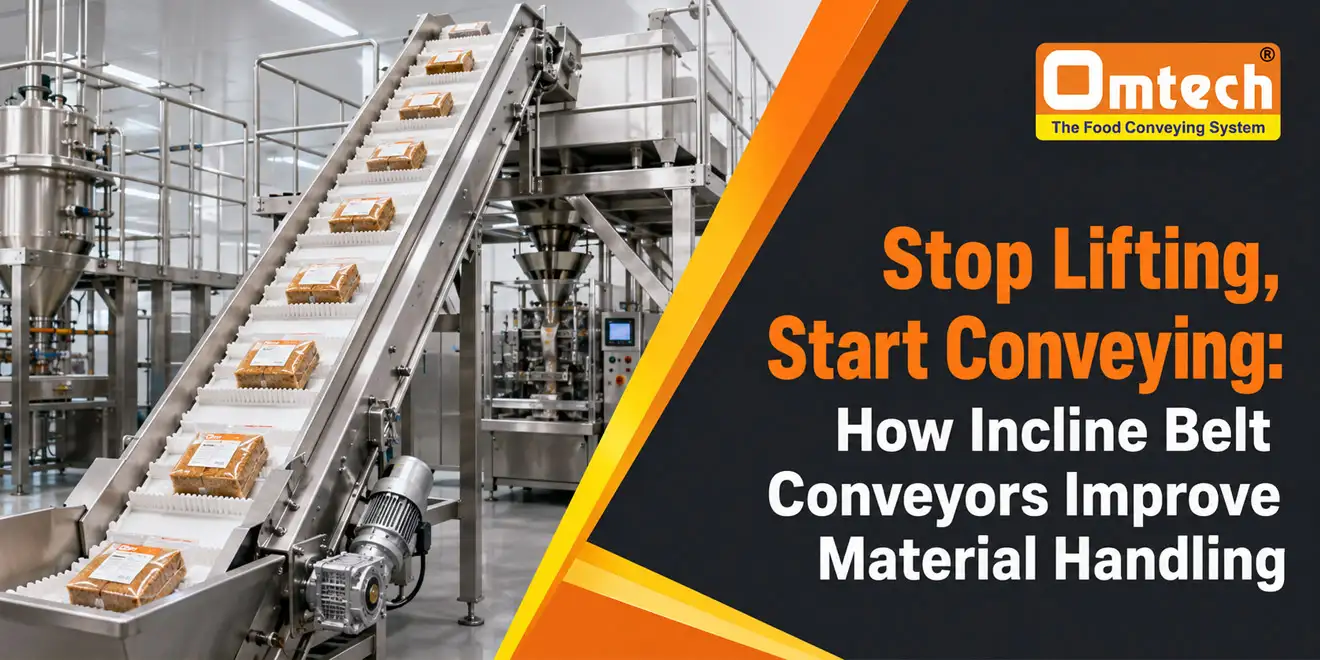
An incline belt conveyor removes that bottleneck by handling the vertical movement mechanically instead of manually. Omtech Food Engineering makes incline belt conveyors specially designed for these transitions, allowing materials to move between different levels without the need for manpower to lift the materials up.
An Incline Belt Conveyor is a machine that carries goods upward in a slanted way by means of a continuously moving belt and generally equipped with cleats in order to prevent the movement of products in the opposite direction during the process. Incline conveyors differ from flat ones in that they are designed to deal with gravity action against the load.
Manually carrying material results in unpredictability that is difficult to work with. Not all employees lift at the same speed, workers tire as time passes and repeated lifting increases the likelihood of injuries, especially in case of heavy or awkward lifting. In addition to the issue of safety, manually carried materials limit production according to a human rate which, in turn, limits the whole production line.
1. Reduces Manual Lifting
Moving material vertically mechanically removes the physical strain of repeated lifting, which directly reduces fatigue related slowdowns and injury risk on the floor.
2. Creates a Continuous Material Flow
Instead of material arriving in batches carried by hand, an incline conveyor keeps a steady stream moving between levels, which smooths out the pace of downstream processes.
3. Makes Better Use of Available Space
Incline conveyors move material vertically within a smaller footprint than a long horizontal run would need, which matters in facilities where floor space is already tight.
4. Improves Handling Consistency
A mechanical system moves material at a fixed, predictable speed every time, unlike manual handling, where pace and care vary from person to person and shift to shift.
5. Supports Safer Material Movement
Removing repetitive lifting from a task reduces the most common source of handling injuries, while covers and guarding on the conveyor itself add further protection around moving parts.
Food production environments bring their own requirements. Belts need to handle regular washdown, resist bacterial buildup, and meet hygiene standards specific to food contact surfaces. Incline conveyors used here are typically built with food grade belting, stainless steel frames, and designs that avoid hard to clean crevices where product residue could collect.
The incline belt conveyor can transport a variety of materials according to the type of belt and cleats, which include packaged materials, loose material, bulk materials being transferred from one process stage to another, bagged materials, fruits and vegetables, among others. Cleats should be of the appropriate height for the type of material transported.
Not every incline conveyor is built for food production, and that distinction matters more than people expect until hygiene compliance becomes an issue. Omtech Food Engineering designs incline belt conveyors specifically for food and beverage handling, factoring in washdown requirements, food safe materials, and layouts suited to real production lines. Each conveyor is built around the actual product, incline angle, and throughput needs of the facility it's going into.
Manual lifting is not supposed to be the permanent solution for the production process, but this is the gap that needs to be covered. The incline belt conveyor is used to cover that gap by moving materials continuously from one level to another without the use of manual lifting.
Omtech Food Engineering, known for providing incline belt conveyors built for food processing environments, works directly with facilities to design a system suited to their specific product and layout. If manual lifting is still part of your process somewhere, it's worth looking at where a conveyor could take that job over. You can explore the full range at omtechfoodengg.com .
Yes, with the right frame material and weather protection, though food grade applications typically stay indoors for hygiene reasons.
Cleats create a physical barrier that stops material sliding backward down the belt, which matters more as the incline angle increases.
Not particularly, though regular belt inspection and cleaning are important, especially in food processing settings with frequent washdown cycles.

Hadamtala Industrial Area,
Opp. HP Petrol Pump. NH 27, Dist: Rajkot Gujarat, India.




 +91 9879670483
 info@omtechfoodengg.com