 By Admin
 August 31, 2026
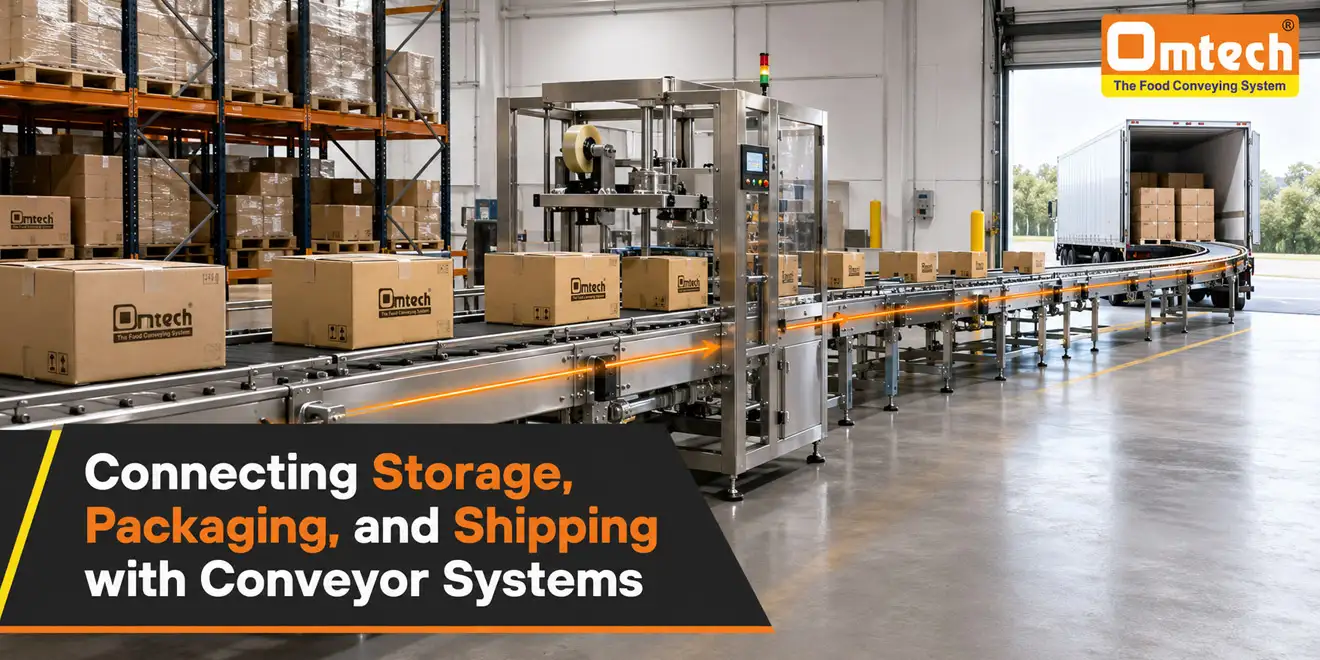
Most warehouses don't have a bottleneck problem in one place. They have three — getting product out of storage, getting it through packaging, and getting it onto a truck without a pile-up forming somewhere in between. Warehouse conveyor systems exist specifically to close those gaps, and once a facility gets past a certain size, running the floor without one stops being realistic.
Storage and packaging are usually run as separate zones, sometimes by different teams entirely. Product sits in racking until it's picked, and then it has to physically travel to wherever packaging happens. In a lot of warehouses, that travel used to mean forklifts, hand trucks, or workers walking pallets across the floor. All of it slow, and all of it a chance for product to sit idle waiting on the next step.
The conveyor system becomes the walk itself. It takes product from the picking zone directly to the packing process, without the need for anybody to manually transport it there. This reduces order cycle time by itself, especially in warehouses where there is a large number of Stock Keeping Units and pickers keep changing zones.
The packaging-to-shipping handoff is usually where warehouses feel the most pain if it isn't automated. Packaged goods need to get sorted, labeled, and staged for the right carrier or the right dock, often within a tight shipping window. Doing that by hand means workers physically sorting boxes by destination, and that gets messy fast once order volume climbs.
The conveyors designed for this process may contain a system which can scan barcodes and divert the packages into their respective lanes or docks. That kind of automatic routing is hard to replicate manually without adding a lot of labor, and even then, manual sorting tends to introduce more errors than an automated line does.
For businesses involved in food production, speed is not the only attribute that matters when using conveyor belts. Any time lost in the transport process means that the products will suffer in terms of quality, since there is a clock ticking as soon as the products are taken out of cold storage. The conveyors used in food production facilities can be made of stainless steel or food-safe plastics.
Temperature is its own challenge. Some conveyor lines run straight through refrigerated or frozen zones, which means the equipment has to hold up under conditions that would degrade a standard industrial conveyor over time. This is one area where a generic conveyor system and one actually engineered for food handling start to look very different, even if they seem similar on paper.
A conveyor system designed to deal with just one of the stages does not have much use by itself. The actual benefit is achieved through integration of storage, packaging, and delivery into one continuous operation rather than three separate operations that are located close to each other. This often entails equalizing the conveyor speeds in order to avoid bottlenecks, as well as making the system flexible enough to accommodate all kinds of products without frequent manual intervention.
Layout tends to matter more than people expect going in. A conveyor system designed without accounting for how a specific warehouse actually runs — where the pinch points are, where volume spikes happen, where product changes shape or weight — tends to underperform no matter how good the equipment itself is.
As order volume grows, so does the cost of not having connected conveyor systems. Labor gets stretched thinner trying to move product manually between zones, error rates climb, and shipping windows get harder to hit consistently. Warehouses that invest in a properly designed conveyor system tend to absorb volume spikes without throwing more people at the problem every time demand goes up.
At Omtech Food Engineering, that's the part we spend the most time on — not just installing warehouse conveyor systems, but manufacturing systems where storage, packaging, and shipping actually work as one line instead of three disconnected steps. You can explore our full solution range at omtechfoodengg.com.
Warehouse conveyor systems are automated material handling systems that move products from storage areas to packaging, sorting, and shipping areas. They increase the efficiency of work processes by cutting down manual handling and facilitating order processing.
A conveyor system makes the flow of material smooth in a warehouse by removing the waiting time between storage, packaging, and shipment, resulting in greater efficiency.
Warehouse conveyors are found to be useful in many industries including food industry, FMCG, e-commerce, pharmaceutical, manufacturing, logistics, automotive, and retail distribution.

Hadamtala Industrial Area,
Opp. HP Petrol Pump. NH 27, Dist: Rajkot Gujarat, India.




 +91 9879670483
 info@omtechfoodengg.com